

Your Skin Isn't the Problem. The Unpredictability Is.
If you have rosacea, you already know this isn't about being "a bit red." This is about waking up every morning and bracing for impact.
There's a ritual that most rosacea sufferers know intimately. You wake up, and before you do anything else, before coffee, before checking your phone, you go to the mirror. Not out of vanity. Out of caution.
What kind of skin day is today going to be?
And the frustrating, exhausting, maddening answer is you won't know until it decides to tell you. That's the real heart of rosacea. Not the redness itself, but the fact that you can never quite trust your own face.
The first truth
"It was fine this morning. Now I look like this."
If there's one sentence that captures life with rosacea, it's that one. You can do everything right, eat carefully, choose gentle products, and avoid every trigger on the list and still find yourself flushed, burning, and inflamed by midday. Sometimes there's no reason at all. Just heat, stress, a glass of wine, a warm room, and a skincare product that was completely fine last Tuesday.
Suddenly your face is hot, red, tight, and completely out of your control. And the worst part isn't even how it looks. It's the loss of trust. Because when you can't rely on your own skin to behave predictably, you stop being able to just live your life. You start managing around it instead.
"I cancelled plans last week because I woke up looking like I'd been sunburned. I was too embarrassed to explain. I just said I wasn't feeling well."
That cancellation? It wasn't dramatic. It was just a quiet, exhausting decision that rosacea forces on you over and over again. Quietly reshaping your life around what your skin might do.
The second truth
"I feel like everyone can see it."
Rosacea is visible in a way that most skin conditions aren't. You can't opt out of it. Makeup doesn't sit right; it clings to texture, separates on inflamed skin, or gets pushed through the moment flushing starts. And when it does flare, it's not subtle. It's heat. It's redness. It's attention you didn't ask for.
"People ask me if I'm sunburnt. Or if I'm embarrassed about something. Or if I've been crying. I'm just standing here having a normal conversation."
Even when no one says anything, you feel watched. And that creates something much heavier than a skin concern; it creates a social anxiety that starts to quietly change how you move through the world.
You avoid hot restaurants. You hesitate before exercise classes. You choose seats away from windows. You turn down the heating even when you're cold. You start building your entire day around damage control, and at some point, you stop noticing you're doing it.
The third truth
"Everything I try makes it worse."
Here's something almost every rosacea sufferer has in common: they haven't just tried one or two things. They've tried everything. Pharmacy staples. Prescription treatments. Viral recommendations. "Gentle" skincare. "Active" skincare. The thing their friend swore by. The thing a dermatologist prescribed three years ago.
And somewhere in that long, expensive journey, something burned them. Something triggered a flare. Something that was supposed to help made everything worse for weeks.
So now there's hesitation. Even when something sounds genuinely promising, there's a voice underneath it saying, 'What if this sets me off again?'
"I've spent hundreds of pounds on products that either did nothing or made me worse. I'm at the point where I'm scared to try anything new. My skin is already fragile, I can't afford another reaction."
This isn't being difficult. This is someone who has been burnt, literally and figuratively, and is trying to protect themselves. The hesitation is earned.
The fourth truth
"I don't even know what my skin actually needs anymore."
Rosacea rarely shows up alone, and this is where it becomes genuinely complicated. Many people dealing with rosacea are also navigating one or two other overlapping conditions at the same time: rosacea and acne, rosacea and a compromised barrier, or rosacea and seborrhoeic dermatitis.
Each one pulls in a different direction. Treat the acne aggressively; the rosacea flares up. Focus on calming the rosacea, and the breakouts return. Try to repair the barrier; congestion builds up. Nothing feels like it works long-term, because treating one thing triggers another.
And then there's the advice. Oh, the advice. Use actives. Don't use actives. Exfoliate regularly. Never exfoliate. You've probably been told completely opposite things by completely confident people.
"I've been treated like an acne client, a sensitive skin client, a dehydrated skin client. Everyone has a different theory. I've stopped knowing who to believe."
The confusion isn't a lack of trying. It's an abundance of conflicting guidance from people who are looking at one piece of the puzzle and calling it the whole picture.
The fear beneath all of it
What rosacea clients are actually afraid of.
Underneath all the day-to-day frustrations are some much quieter, deeper fears. The ones that don't always get said out loud but drive almost every decision.
The fear that this is permanent. Most people with rosacea have been told at some point that there's no cure, only management. That lands hard. Because "management" starts to sound a lot like "this is just your life now". So they live in a strange tension between resignation and desperation: resigned to the idea that it might never fully clear, desperate to find the one thing that might finally work.
The fear of making it worse. Every new product, every new treatment, every new recommendation carries risk. And when you've already had bad experiences – reactions, flares, months of setbacks – that risk feels enormous. So even when they genuinely want to try something, there's a protective instinct pulling them back.
The fear of losing control in public. Flushing is fast. It's visible. You can't hide it, redirect it, or wait it out. The fear of going red in a meeting, during a first date, or in a job interview – that fear is real and constant. Rosacea doesn't just live on your face. It lives in your nervous system, quietly shaping every social interaction.
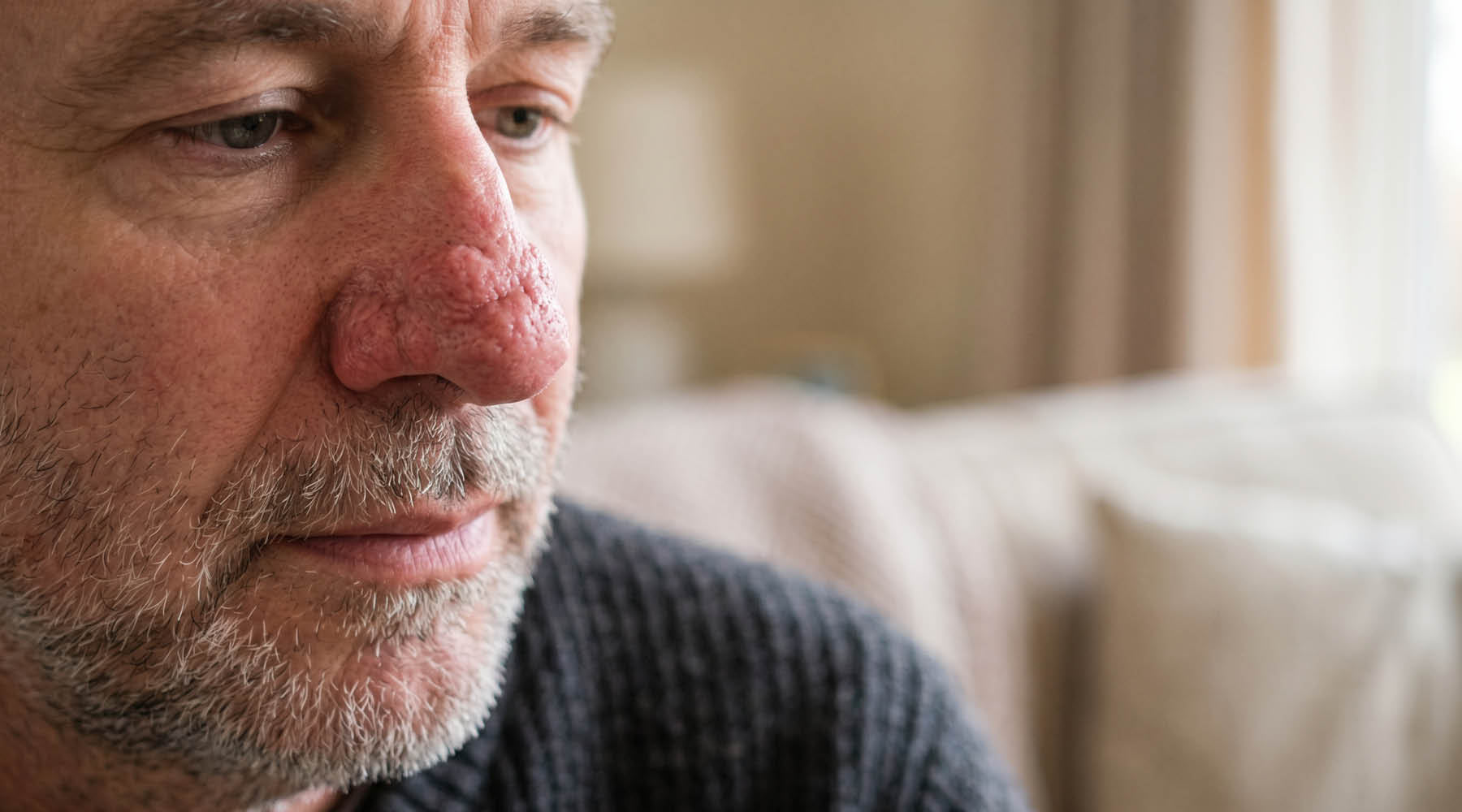
The fear of looking damaged. Chronic inflammation changes the skin over time. Persistent redness, broken capillaries, texture changes, visible sensitivity. Clients don't just see "rosacea". They see what they're worried the world sees: skin that looks unhealthy, reactive, older than it should. It doesn't reflect who they feel they are inside.
The fear of not being understood. Friends and family say things like, "It's just a bit of redness," or "Have you tried drinking more water?" Even well-meaning professionals sometimes treat rosacea like sensitivity, or like acne, or like a straightforward condition that just needs the right cream. The experience of being oversimplified, dismissed, or misunderstood is one of the loneliest parts of living with this condition.
What's actually driving it
Rosacea isn't a surface problem.
One of the reasons so many approaches fail rosacea sufferers is that they focus only on what can be seen: the redness, the bumps, and the inflammation. But rosacea is driven by what's happening underneath, immune system dysregulation, neurovascular instability that causes flushing, barrier dysfunction that makes skin hyper-reactive, and microbiome imbalance that perpetuates the cycle.
If those underlying drivers aren't addressed, the most any treatment can do is manage the symptoms temporarily. The flares keep coming. The reactivity stays. The cycle continues.
This is why rosacea sufferers often feel stuck even when they're doing everything they've been told to do. They're not being failed by their own effort. They're being failed by approaches that aren't looking at the full picture.
What actually changes things
When rosacea is approached properly, something shifts.
The skin becomes more predictable. Flare-ups reduce in frequency. Reactivity decreases. Products stop feeling like a gamble. You stop waking up bracing for what the mirror is going to show you.
And when that happens, something that goes well beyond skincare starts to change too. You start to trust your face again. You stop planning your week around what your skin might do. You go back to the restaurant, book the exercise class, and sit near the window.
Rosacea clients don't just want clearer skin. They want their normal back, the version of their life where they're not constantly managing their face.
The redness was never really the point. The point was always the freedom underneath it: to feel confident walking into a room, to stop mid-conversation without checking your reflection, to stop spending mental energy on something that should just be your skin.
If this sounds like you
You're not imagining it. You're not being oversensitive. And you're not stuck with this forever. What you need isn't more products to try, it's an approach that actually addresses what's happening beneath the surface.
The right treatment plan for rosacea works with your skin's biology, not against it, calming the underlying drivers, rebuilding your barrier, and giving you back the one thing rosacea takes most: predictability.
Because consistency isn't too much to ask for from your own skin.
Read more
Most people picture rosacea as redness, flushing, or the occasional breakout. Something to manage, to cover, to keep under control.But rosacea has a less-talked-about endpoint, one that goes well b...

If you have rosacea, chances are someone has recommended azelaic acid. Your dermatologist, a skincare forum, or a well-meaning friend. And for good reason — it genuinely works for a lot of people. ...